Othello Game
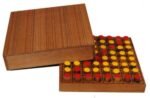
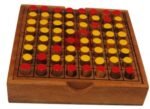
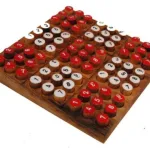
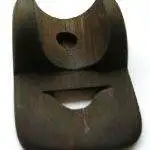
Beautiful Wooden Othello Game.
Made in Thailand from Rainwood. This is a beautifully carved board game that would make a unique gift or for the family collections.
Traditional Brain teaser/ IQ strategy puzzle board game.
Dimensions: 13x13x2.5cm.
Comes with instructions for the classic game.
Wooden pieces and wooden box. Colours of the wooden pieces may vary from pictures.
The unpacked weight of this item is 220g approx.
This is not a toy – not suitable for children due to small pegs.
We sell many other wooden traditional games.
Othello Game Rules
Each of the disks’ two sides corresponds to one player; they are referred to here as light and dark after the sides of Othello pieces, but any counters with distinctive faces are suitable. The game may for example be played with a chessboard and Scrabble pieces, with one player letters and the other backs.
The historical version of Reversi starts with an empty board, and the first two moves made by each player are in the four central squares of the board. The players place their disks alternately with their colors facing up and no captures are made. A player may choose to not play both pieces on the same diagonal, different from the standard Othello opening. It is also possible to play variants of Reversi and Othello where the second player’s second move may or must flip one of the opposite-colored disks (as variants closest to the normal games).
For the specific game of Othello, the game begins with four disks placed in a square in the middle of the grid, two facing light-side-up, two dark-side-up, so that the same-colored disks are on a diagonal. Convention has this such that the dark-side-up disks are to the north-east and south-west (from both players’ perspectives), though this is only marginally consequential: where sequential openings’ memorization is preferred, such players benefit from this. The dark player moves first.
Dark must place a piece (dark-side-up) on the board and so that there exists at least one straight (horizontal, vertical, or diagonal) occupied line between the new piece and another dark piece, with one or more contiguous light pieces between them. For move one, dark has four options shown by translucently drawn pieces below:
Play always alternates unless one player has no legal move, in which case they pass. After placing a dark disk, dark turns over (flips to dark, captures) the single disk (or chain of light disks) on the line between the new piece and an anchoring dark piece. Multiple chains of disks may be captured in a single move. No player can look back to the previous status of disks when playing moves. A valid move is one where at least one piece is reversed (flipped over).
If dark decided to put a piece in the topmost location (all choices are strategically equivalent at this time), one piece gets turned over, so that the board appears thus:
Players take alternate turns. If one player cannot make a valid move, play passes back to the other player. When neither player can move, the game ends. This occurs when the grid has filled up or when neither player can legally place a piece in any of the remaining squares. This means the game may end before the grid is completely filled. This possibility may occur because one player has no pieces remaining on the board in that player’s color. In over-the-board play this is generally scored as if the board were full (64–0).
Examples where the game ends before the grid is completely filled:
The player with the most pieces on the board at the end of the game wins.







 Badges Keyrings
 Bamboo Products
 Ethnic Basketry
 Blankets Throws
 Coffee Lovers
 Cork from Portugal
 Crafted Signs
 Cushion Covers
 Door Curtains from Nepal
 Driftwood Items
 Ethnic Pipes
 Fireplace Items
 World Flags
 Furniture
 Garden Items
 Kitchenware Bar
 Handmade Lighting
 Tribal Masks
 Handmade Metalwork
 Other Home & Garden
 Handmade Ornaments
 Moroccan Pouffes
 Handmade Rugs
 Sleeping Bags
 Handmade Stationery
 Handmade Tableware
 Tapestry Hangers
 Handcrafted Woodcrafted









 Mens Costumes
 Football Shirts
 Mens Headwear
 Mens Hoodies
 Mens Ponchos
 Mens Scarves
 Shirts & Tees
 Mens Slippers
 Mens Socks
 Dungarees & Trousers
 Womens Clothing
 Womens Accessories
 Ladies Dresses
 Ladies Headwear
 Ladies Hoodies
 Ladies Ponchos
 Ladies Scarves
 Ladies Shorts
 Ladies Footwear
 Socks & Legwarmers
 Tops & T-shirts
 Trousers & Dungarees
 Backpacks
 Bumbags Fanny Packs
 Wallets Purses
 Yoga Bags
 Bracelet
 Pendants
 Indian Carrom
 Chess Backgammon
 Other Traditional Games
 Outdoor Games
 Wooden Puzzles
 Handpans
 Percussion
 Handmade Drums
 Hand Percussion
 Other Percussion
 String Instruments
 Kanun | Qanun
 Dan Bau
 Sitar
Sitar Spare Parts | Replacement Strings | Accessories
 Woodwind
 Hand Made Soap
 Made by Others
 Made by Terrapin Trading
 Solid Perfume
 Felt Balls
 Tartan Offcuts

Reviews
There are no reviews yet.