


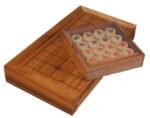
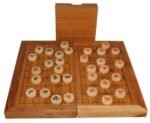

Xiangqi Chess – Elephant Chess – Wooden Set
Original price was: £37.99.£30.00Current price is: £30.00.
Xiangqi Chess – Lovely wooden Chinese Chess set with magnetic close board. Made from Rainwood from Northen Thailand. Great strategy game.
In stock
Xiangqi Chess
Lovely wooden Xiangqi chess with magnetic close board.
Made from Rainwood from Northen Thailand. Beautiful carved set that would make a unique gift or for the family collections. Great strategy game.
Board Dimensions approx 30cm x 30cm x 2cm (closes to 15cmx 30cm x 4cm).
Resin pieces and wooden box.
Comes with a lightweight polythene board map.
This is not a toy – not suitable for children due to small pieces.
We sell many other wooden traditional games.Please see our other games. We sell a whole range of wooden games from around the world.
Background
Xiangqi (Chinese: 象棋; pinyin: xiàngqí; Wade–Giles: Hsiang ch’i; English: /ˈʃɑːŋtʃi/), commonly known as Chinese chess or elephant chess, is a strategy board game for two players. It is the most popular board game in China. Xiangqi is in the same family of games as shogi, janggi, Western chess, chaturanga, and Indian chess. Besides China and areas with significant ethnic Chinese communities, this game is also a popular pastime in Vietnam, where it is known as cờ tướng, literally ‘General’s chess’.
The game represents a battle between two armies, with the primary object being to checkmate the enemy’s general (king). Distinctive features of xiangqi include the cannon (pao), which must jump to capture; a rule prohibiting the generals from facing each other directly; areas on the board called the river and palace, which restrict the movement of some pieces but enhance that of others; and the placement of the pieces on the intersections of the board lines, rather than within the squares.
Xiangqi Chess Board

Xiangqi is played on a board nine lines wide and ten lines long. As in the game Go (圍碁; or Wéi qí 圍棋), the pieces are placed on the intersections, which are known as points. The vertical lines are known as files (Chinese: 路; pinyin: lù; “road”), and the horizontal lines are known as ranks (Chinese: 線/綫; pinyin: xiàn; “line”).
Centred at the first to third and eighth to tenth ranks of the board are two zones, each three points by three points, demarcated by two diagonal lines connecting opposite corners and intersecting at the centre point. Each of these areas is known as 宮  gōng, a palace.
Dividing the two opposing sides, between the fifth and sixth ranks, is 河 hé, the “river”. The river is usually marked with the phrases 楚河 chǔ hé, meaning “River of the Chu “, and 漢界 hàn jiè, meaning “Border of the Han“, a reference to the Chu–Han War. Although the river (or Hanchu boundary) provides a visual division between the two sides, only two pieces are affected by its presence: soldiers have an enhanced move after crossing the river, and elephants cannot cross it. The starting points of the soldiers and cannons are usually, but not always, marked with small crosses.
Rules

The pieces start in the position shown in the diagram above. Which player moves first has varied throughout history and from one part of China to another. Different xiangqi books advise either that the black or red side moves first. Some books refer to the two sides as north and south; which direction corresponds to which colour also varies from source to source. Generally, Red moves first in most modern tournaments.
Each player in turn moves one piece from the point it occupies, to another point. Pieces are generally not permitted to move through points occupied by other pieces, the exception being the cannon’s capturing move. A piece can be moved onto a point occupied by an enemy piece, in which case the enemy piece is captured and removed from the board. A player cannot capture one of their own pieces. Pieces are never promoted (converted into other pieces), although the soldier gains the ability to move sideways after it crosses the river. Almost all pieces capture using their normal moves, while the cannon has a special capture move described below.

The game ends when one player checkmates the other’s general. When the general is in danger of being captured by the enemy player on their next move, the enemy player has “delivered a check” (照將/將軍, abbreviated as 將 jiāng), and the general is “in check”. A check should be announced. If the general’s player can make no move to prevent the general’s capture, the situation is called “checkmate” (將死). Unlike in chess, in which stalemate is a draw, in xiangqi, it is a loss for the stalemated player.
In xiangqi, a player—often with a material or positional disadvantage—may attempt to check or chase pieces in a way such that the moves fall in a cycle, preventing the opponent from winning. While this is accepted in Western chess, in xiangqi, the following special rules are used to make it harder to draw the game by endless checking or chasing, regardless of whether the positions of the pieces are repeated or not:
- A player making perpetual checks with one piece or several pieces can be ruled to have lost unless he or she stops such checking.
- A player who perpetually chases any one unprotected piece with one or more pieces, excluding generals and soldiers, will be ruled to have lost unless he or she stops such chasing.
- If one side perpetually checks and the other side perpetually chases, the checking side has to stop or be ruled to have lost.
- When neither side violates the rules and both persist in not making an alternate move, the game can be ruled as a draw.
- When both sides violate the same rule at the same time and both persist in not making an alternate move, the game can be ruled as a draw.
Different sets of rules set different limits on what is considered perpetual. For example, club xiangqi rules allow a player to check or chase six consecutive times using one piece, twelve times using two pieces, and eighteen times using three pieces before considering the action perpetual.
The above rules to prevent perpetual checking and chasing, while popular, are not the only ones; there are numerous end game situations.
| age group |
adult |
|---|---|
| Brand |
Terrapin Trading Ltd |
Only logged in customers who have purchased this product may leave a review.







 Mens Costumes
 Football Shirts
 Mens Headwear
 Mens Hoodies
 Mens Ponchos
 Mens Scarves
 Shirts & Tees
 Mens Slippers
 Mens Socks
 Dungarees & Trousers
 Womens Clothing
 Womens Accessories
 Ladies Dresses
 Ladies Headwear
 Ladies Hoodies
 Ladies Ponchos
 Ladies Scarves
 Ladies Shorts
 Ladies Footwear
 Socks & Legwarmers
 Tops & T-shirts
 Trousers & Dungarees
 Backpacks
 Bumbags Fanny Packs
 Wallets Purses
 Yoga Bags
 Bracelet
 Pendants
 Badges Keyrings
 Bamboo Products
 Ethnic Basketry
 Blankets Throws
 Coffee Lovers
 Cork from Portugal
 Crafted Signs
 Cushion Covers
 Door Curtains from Nepal
 Driftwood Items
 Ethnic Pipes
 Fireplace Items
 World Flags
 Furniture
 Garden Items
 Kitchenware Bar
 Handmade Lighting
 Tribal Masks
 Handmade Metalwork
 Other Home & Garden
 Handmade Ornaments
 Moroccan Pouffes
 Handmade Rugs
 Sleeping Bags
 Handmade Stationery
 Handmade Tableware
 Tapestry Hangers
 Handcrafted Woodcrafted
 Indian Carrom
 Chess Backgammon
 Other Traditional Games
 Outdoor Games
 Wooden Puzzles
 Handpans
 Percussion
 Handmade Drums
 Hand Percussion
 Other Percussion
 String Instruments
 Kanun | Qanun
 Dan Bau
 Sitar
Sitar Spare Parts | Replacement Strings | Accessories
 Woodwind

 Hand Made Soap
 Made by Others
 Made by Terrapin Trading
 Solid Perfume
 Felt Balls
 Tartan Offcuts




Reviews
There are no reviews yet.